
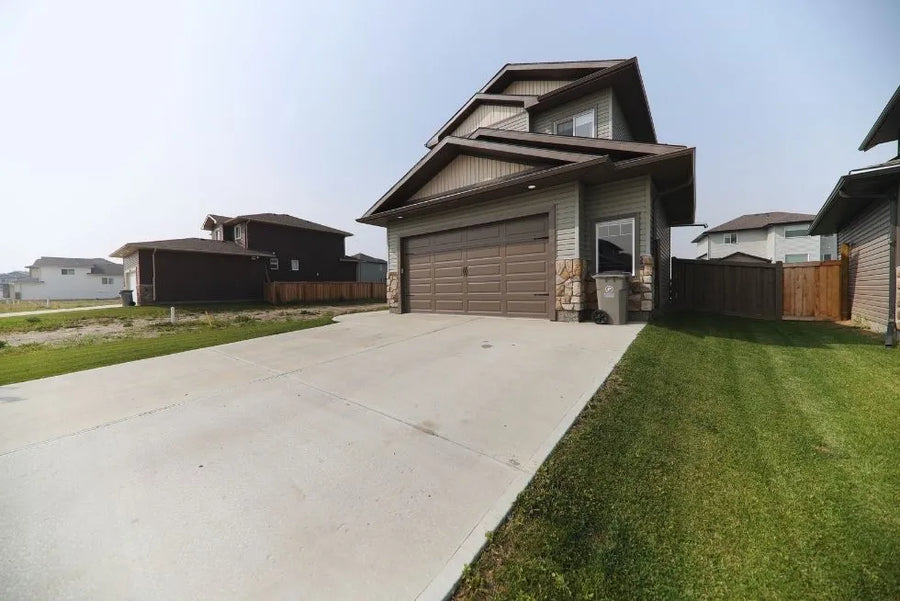
What this service includes
We remove the old surface, rebuild and compact the stone base, set forms to drain water away from your home, reinforce the slab, and place an air-entrained concrete mix suited to Indiana winters.
Control joints are cut at planned spacing so the inevitable shrinkage happens in a straight, hidden line instead of a random crack across the middle of your driveway.
Who it's right for
- Driveways that are spalling, heaving, settling, or cracked beyond patching
- Gravel drives a homeowner wants to convert to a permanent hard surface
- New construction and additions such as extra parking pads or turnarounds
- Homes where drainage or standing water needs to be corrected during the pour
Options available
- Standard broom finish
- The most common residential finish. Slip resistant, clean, and the most cost-effective option.
- Thickened edges & heavier pours
- 5" to 6" slabs for RV pads, work trucks, and equipment traffic.
- Decorative borders
- A stamped or exposed border around a broom-finished field adds definition without the cost of a fully decorative drive.
- Stamped or colored driveways
- Full decorative treatment for homeowners who want the driveway to match a stone or paver look.
- Apron and approach work
- Tying new concrete cleanly into the street, sidewalk, and garage slab.
What installation involves
- 1
On-site review
We walk the property, check drainage and access, measure, and talk through thickness, reinforcement, and finish.
- 2
Demo and haul-away
Old concrete is broken out and removed. Nothing gets buried on your property.
- 3
Base preparation
Grading and compacted stone. This step is what determines whether a driveway settles later.
- 4
Forming and reinforcement
Forms set to grade for positive drainage, then rebar or mesh as the design requires.
- 5
Placement and finishing
Concrete is placed, screeded, floated, and finished, then jointed at planned spacing.
- 6
Curing and cleanup
Curing measures applied, site cleaned, and we review protection and timing with you before we leave.
What affects the cost
Every project is priced from an on-site measurement, because these variables change the number far more than square footage alone:
- Square footage and overall shape — curves and small pours cost more per foot than large rectangles
- Slab thickness and reinforcement required for your vehicles
- Tear-out and disposal of an existing driveway
- How much base repair, grading, or fill the site needs
- Access for trucks and equipment
- Finish selection — broom versus decorative, borders, or color
- Any drainage correction, retaining, or approach work
How long it takes
Most residential driveways are demo'd and poured within two to three working days on site, weather permitting. You can usually walk on the surface after 24 to 48 hours, and drive passenger vehicles on it after roughly 7 days. Heavy trucks and equipment should wait closer to 28 days.
Maintenance
- Keep de-icing salts off new concrete through the first winter — snow removal instead of chemicals
- Seal when the surface is fully cured, then re-seal on the schedule your installer recommends
- Keep joints clean and re-caulk expansion joints as they age
- Don't let downspouts or irrigation discharge under the slab edge
Common homeowner mistakes
- Choosing a bid that skips base prep — thickness cannot make up for a poor base
- Applying rock salt during the first winter, which causes surface spalling
- Assuming all cracking is a defect; controlled shrinkage cracking at joints is normal in concrete
- Parking heavy equipment or dumpsters on a slab before it has gained strength
Why choose Hoosier Concrete Pros
We're a locally owned residential concrete contractor working across Indianapolis and Central Indiana. Kyle King is on the projects, estimates are free and itemized, and our work carries a 3-year workmanship warranty. We're licensed and insured, rated 4.9 stars across 53 Google reviews, and we build for Indiana's freeze-thaw cycle — proper base, correct reinforcement, and planned joints on every pour.
Areas we serve
We install concrete driveways throughout Central Indiana, including:
Frequently asked questions
How thick should a residential concrete driveway be?
Four inches is standard for passenger vehicles. We recommend five to six inches with heavier reinforcement where work trucks, RVs, trailers, or frequent delivery traffic are involved.
How long before you can drive on a new concrete driveway?
Foot traffic is generally fine after 24 to 48 hours. Passenger cars after about 7 days. Heavy vehicles should wait about 28 days, when the concrete has reached most of its design strength.
How long does a concrete driveway last in Indiana?
A properly based, reinforced, and jointed concrete driveway commonly lasts 30 years or more in Central Indiana. Salt exposure in the first year and poor drainage are the two things that shorten that life the most.
What causes concrete driveways to crack?
Most cracks come from shrinkage during curing, a base that settles, freeze-thaw movement, or loads heavier than the slab was designed for. Correct joint spacing directs shrinkage into clean lines instead of random cracks.
Can you pour new concrete over an old driveway?
We generally don't recommend it for driveways. Overlays inherit the movement and failures of the slab underneath. Removing and replacing gives a predictable base and a full-life surface.