
What this service includes
Walkways are small projects that carry a lot of curb appeal. They are also the surfaces most likely to become a trip hazard when they settle.
We rebuild the base, set consistent width and slope, and tie landings and steps in at safe, even riser heights.
Who it's right for
- Uneven, cracked, or settled front walks and sidewalks
- New paths connecting a driveway, patio, or side yard
- Entry landings, stoops, and step replacement
- Accessible routes that need controlled slope and consistent surface
Options available
- Broom finish
- Standard, slip-resistant, and easy to maintain.
- Stamped or bordered walks
- Decorative treatment that ties into a stamped patio or entry.
- Exposed aggregate
- Textured and durable, with good traction in wet weather.
- Steps and landings
- Poured steps with even risers and safe tread depth.
- Curved layouts
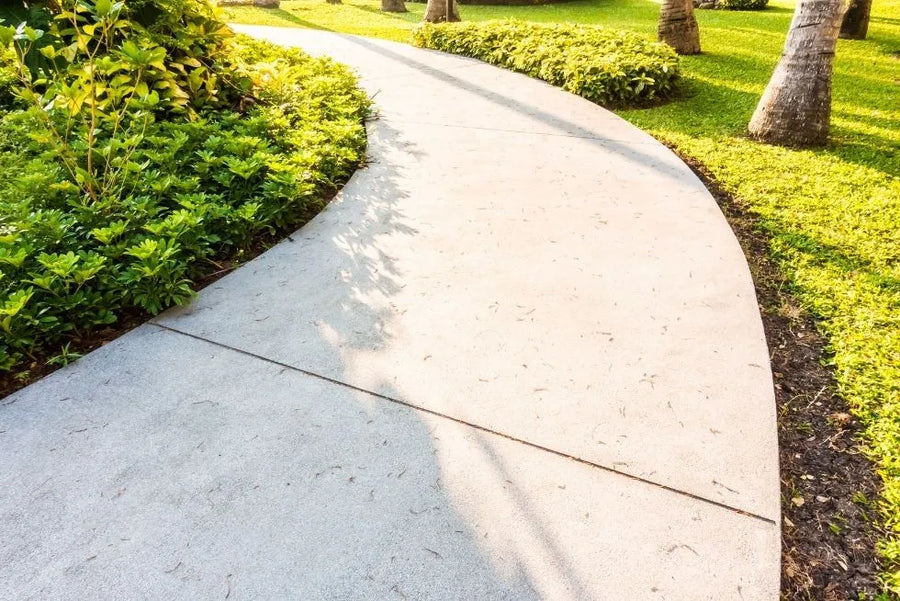
- Soft radius paths that follow landscaping rather than cutting across it.
What installation involves
- 1
Layout
We stake the route, confirm width, and plan slope and transitions.
- 2
Demo and base
Old walk removed; stone base placed and compacted.
- 3
Forming
Forms set for consistent width, slope, and clean radii.
- 4
Pour and finish
Concrete placed, finished to the chosen texture, and edged.
- 5
Joints and cleanup
Joints cut at regular spacing, site restored around the new work.
What affects the cost
Every project is priced from an on-site measurement, because these variables change the number far more than square footage alone:
- Linear footage and walk width
- Removal of an existing walk
- Steps, landings, and elevation changes
- Curves and custom shapes versus straight runs
- Finish selection
- Landscaping or irrigation that needs to be worked around or restored
How long it takes
Most walkway projects are completed in one to two days on site. Foot traffic is usually fine after 24 to 48 hours.
Maintenance
- Shovel rather than salt through the first winter
- Keep joints clear of debris and soil
- Trim back landscaping so roots and irrigation don't undermine the edges
- Seal decorative walks on the same schedule as other decorative concrete
Common homeowner mistakes
- Building a 30-inch walk that two people can't use side by side
- Pouring new walk over a base that was never corrected, so it settles again
- Uneven step risers, which are both a code and a safety problem
- Sloping the walk toward the house or the garage instead of away
Why choose Hoosier Concrete Pros
We're a locally owned residential concrete contractor working across Indianapolis and Central Indiana. Kyle King is on the projects, estimates are free and itemized, and our work carries a 3-year workmanship warranty. We're licensed and insured, rated 4.9 stars across 53 Google reviews, and we build for Indiana's freeze-thaw cycle — proper base, correct reinforcement, and planned joints on every pour.
Areas we serve
We install concrete walkways throughout Central Indiana, including:
Frequently asked questions
How wide should a front walkway be?
We recommend at least 4 feet for a main entry walk so two people can walk side by side comfortably. Secondary paths often work at 3 feet.
Can a settled sidewalk be fixed instead of replaced?
Sometimes. If the slab itself is sound and only settled, lifting can be an option. If it is cracked, spalled, or the base has failed, replacement is the better long-term value.
How thick should a walkway be?
Four inches over a compacted base is standard for pedestrian walkways. We thicken sections that will see vehicle crossings.